
c a n d l e : one
what the first candle of advent teaches us

There’s a reason we light candles in Advent. Not light switches nor lanterns, but candles. Candles are slow. They require attention. And if you sit with one long enough, a candle becomes a teacher.
Consider the way in which contemplative traditions across the world use candles not simply for aesthetic reasons, but because their quiet glow speaks to the curious soul. Somewhere, right now, in a dimly lit Benedictine chapel, rows of tiny flames tremble as monks kneel in silence, each flame flickering a whisper of a prayer. Folks in a quiet Buddhist shrine in a small town are witnessing incense curl toward a single candle, the light reflecting in the eyes of meditating practitioners. On the streets of a candlelit vigil, strangers hold flames together, the glow bridging grief and hope. In Jewish homes, the Shabbat candles shimmer against the night, teaching presence and reverence. Across these spaces, the candle asks only that we notice it, that we slow down and lean in, allowing the small flame to illuminate something deep within us.
During Advent the Church lights four candles: Hope, Peace, Joy, Love. These candles serve as guides throughout the Advent season. They understand something we too often forget: light doesn’t rush; light reveals. If we let them, these candles, their themes, and their small flames reveal far more than light. They inform the curious soul in gentle and transformative ways. As we pay attention to the order they are lit, the way they burn, and how they speak, our souls can be formed in the ways Advent intends.
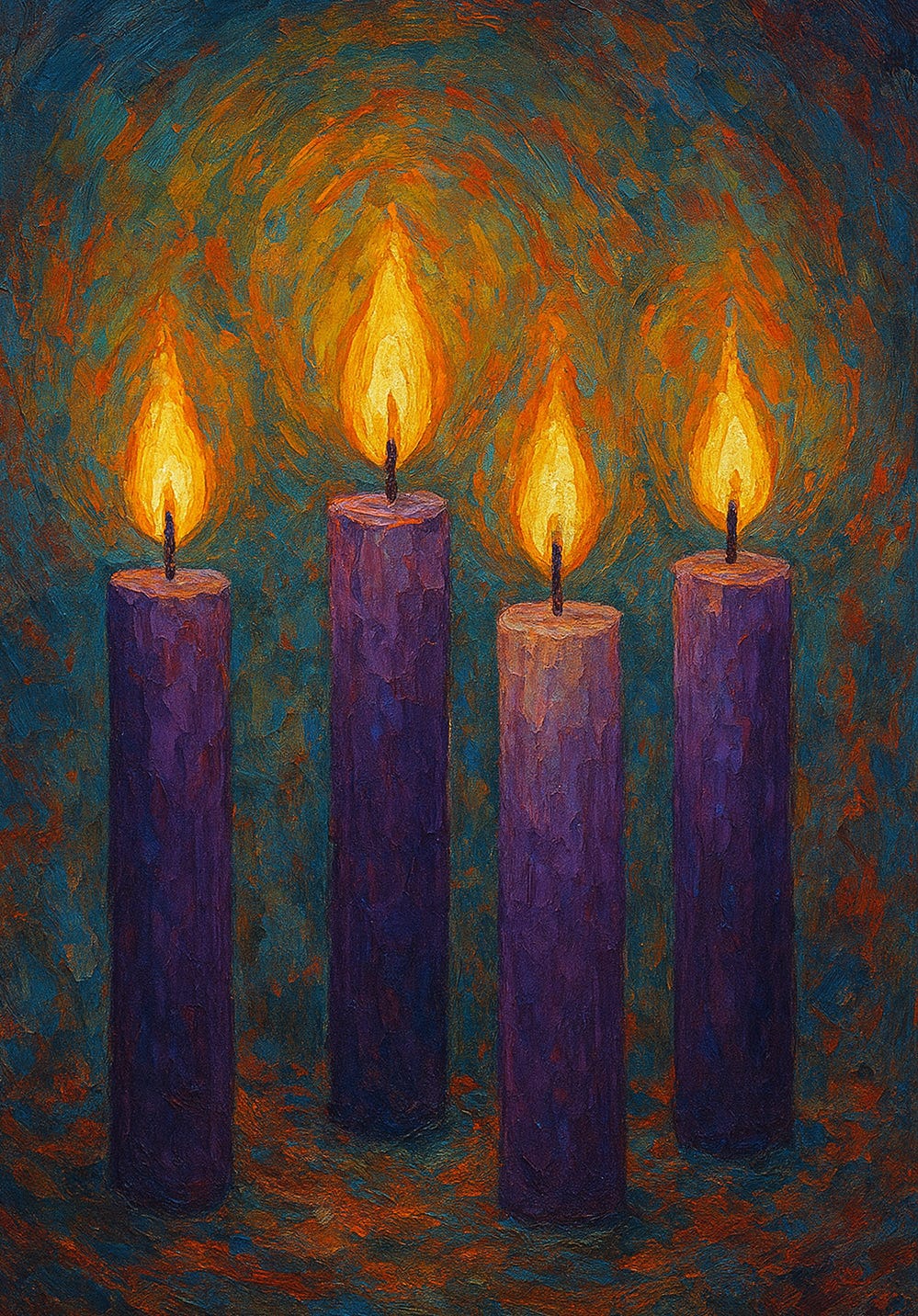
This season, I’ve written 4 essays reflecting specifically on the 4 main candles of Advent, sharing some of the meditations that the candles themselves have offered me as I’ve longed for Divine light to enter into my story once again. And so we begin with the first flame: Hope.
===
Advent is a transformative journey: A journey from darkness to light, from despair to love. The transformation it offers comes precisely because it is a journey. Too often we want to skip the intermediate steps of authentic transformation in the longing to leap straight to the climax of our story. But when one leaps to end, skipping the middle, they leap right over the transformation they are longing for. Spiritual formation happens not upon arrival, but along the path itself. Unless we are willing to slow down, wait, and travel the long path, we miss out on all the journey has to offer.
The beauty of Advent is that it asks us to slow down because it wants us to be transformed. Advent asks us to enter into the same waiting our spiritual ancestors knew, waiting for the promised light that would someday enter their story and ours. It is while we walk this waiting journey that the transformation happens. Here, at the genesis of Advent, at the start of this transformative path, we are invited to ask: how does one enter this journey well? I believe the candles themselves teach us.
To begin a journey toward light, we must first recognize the darkness, not to be swallowed by it, but to acknowledge the need for light.
Advent begins with an honesty that recognizes our need for authentic light. Not a sentimental, artificial, blue, or fluorescent light, but a real, living fire. A light that comes slowly, patiently, like a candle flame. In a world drenched in manufactured illumination, it becomes glaringly obvious that we need something deeper, something more true.
As this journey begins, we look at the collection of unlit candles as a recognition that the room feels dark, but also that there are candles here to be lit. It’s an invitation to what is possible within the darkness. When I look at the circle of unlit candles, I see a community that can light the world ablaze with hope, peace, joy, and love. Each candle is a symbol of promise and potential in the midst of the current darkness.
Too often, when we rightfully recognize the darkness that surrounds us, we pitch a tent there and forget to notice the candles that can still be lit in our story. The whole point of Advent, and the unlit candles that sit at the start of our journey, is not to meditate on the darkness, but to prepare for illumination. To hope for what could be. Which is why the first candle we light on this first Sunday is one of hope.
It could be said that all the advent candles are candles of hope. Hope not as a naïve optimism, but as a deep internal knowing that more light is possible. That darkness is not the end, but a backdrop, a stage for the impending light. Advent begins when we turn our gaze not only to the shadows around us, but to the candles still unlit. And the first candle we light is the one of hope.
Hope is the courage to reach for the match.
===
Today, as you look at the unlit candles, you might ask yourself: Where in your life is light needed right now? Where have you pitched a tent in the darkness, forgetting the candles that could still be lit? Where might you reach for the match: Toward a relationship, a project, a dream, or a small act of care, that invites light to enter?
As you light your first candle, take a moment, sit quietly, and breathe with its flame. Let it remind you that hope is possible, even in the dark. As you watch the flame, you may repeat this mantra silently or aloud:
“I reach for the light. I invite hope. I nurture what can grow.”
===
There are areas of darkness that I can use more light. I will light that candle. TY Tyler. Love you. 💖🙏
I love reflecting on the idea of light as revelation. I'm going to keep that with me this Advent.